

 TripAdvisor

Inca Trail Physical Training Plan: How to Prepare to Hike to Machu Picchu
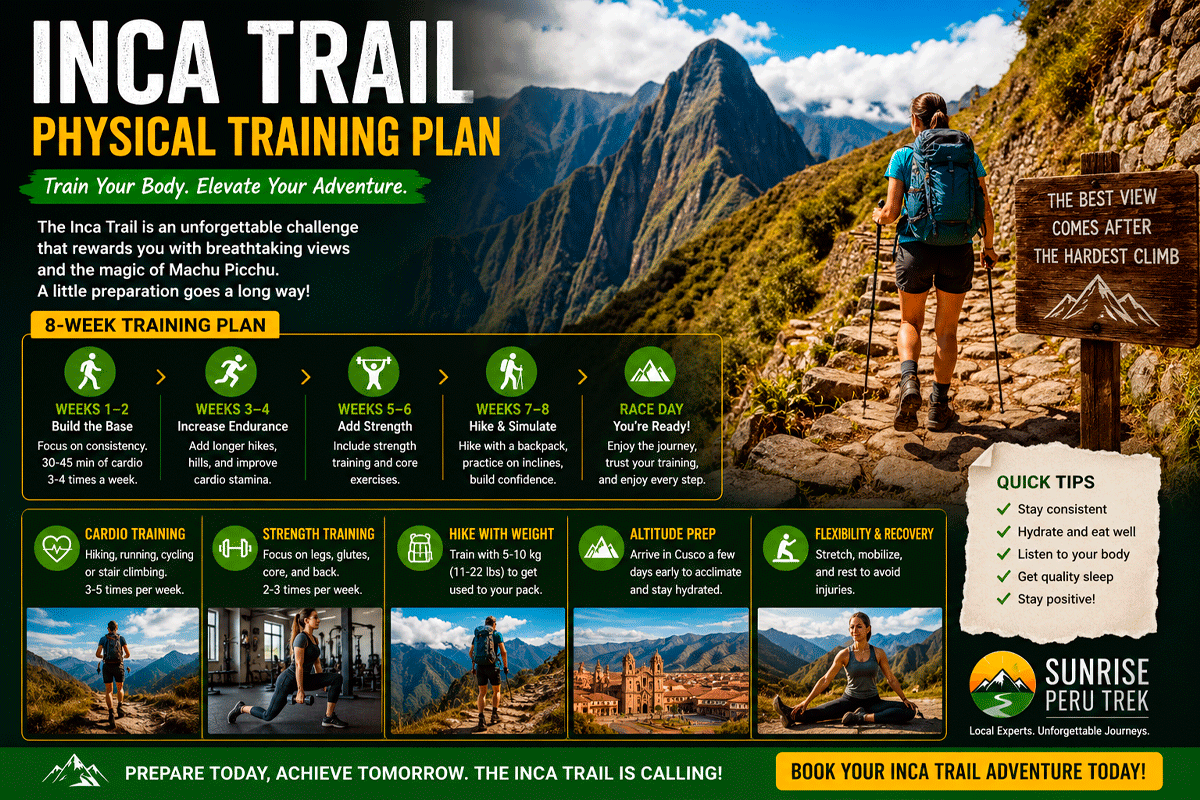
Imagine standing at the Sun Gate as the morning mist parts, revealing the ancient, breathtaking citadel of Machu Picchu below. You take a deep breath, look back at the jagged Andean peaks you just conquered, and smile. Your legs feel strong, your heart rate is steady, and you are fully present in one of the most unforgettable moments on Earth.
Now picture the alternative: gasping for air on day two, nursing brutal blisters, and staring at your boots the whole way up Dead Woman’s Pass.
The difference between a punishing slog and the adventure of a lifetime comes down to one thing: Inca Trail preparation.
The Classic Inca Trail is world-famous for a reason. Over four days, you’ll cross high-mountain passes reaching 4,200 meters (13,779 feet), descend thousands of stone steps, and traverse cloud forests. At Sunrise Peru Trek, we’ve guided thousands of travelers to this iconic sanctuary. We know that with the right Inca Trail Fitness Guide, anyone with moderate health and strong determination can conquer this trail.
Here is your ultimate guide on how to train for the Inca Trail so you can step onto the path with absolute confidence.
Why Physical Preparation Matters
Hiking Machu Picchu isn’t a walk in the park. It’s a multi-day test of endurance, leg strength, and lung capacity.
Proper Inca Trail training does much more than just help you finish the hike. It:
Protects Your Knees and Joints: Decades of stone staircases take a toll on downhills.
Boosts Safety: Fatigue leads to awkward missteps. Stronger muscles keep you agile on uneven terrain.
Maximizes Enjoyment: When you aren’t fighting for air, you actually notice the orchids, the Inca ruins, and the breathtaking views.
The 8-Week Inca Trail Training Plan
Whether you’re a seasoned hiker or a gym novice, launching an 8-week Inca Trail workout plan will set you up for absolute success on your Inca Trail tour.
    [Weeks 1–2] BASE BUILDING: Aerobic foundation & light leg work
         │
    [Weeks 3–4] STRENGTH & STEPS: Weighted stair-climbers & lunges
         │
    [Weeks 5–6] SIMULATION: Weekend hikes carrying a loaded daypack
         │
    [Weeks 7–8] TAPER & MOBILITY: Lower volume, stretching & rest
Cardio & Endurance: Build Your Engine
Aim for 3 to 4 days a week of steady cardio.
Stair-Climbing: The stair-master or local stadium bleachers will be your best friend. The trail features over 10,000 stone steps!
Incline Treadmill Walking: Set the incline to 8–12% and keep a steady pace for 45–60 minutes.
Cycling or Swimming: Great low-impact cross-training to build lung capacity without pounding your joints.
Leg & Core Strength: Your Andean Armor
Focus on functional movements 2 to 3 days a week:
Weighted Lunges & Step-ups: Target your quads, hamstrings, and glutes for steep ascents.
Goblet Squats: Build power for the long trail days.
Planks & Farmer’s Carries: A stable core carries your daypack comfortably and protects your lower back.
Practice Hiking with a Backpack
Never hit the Inca Trail Trek with untested gear!
At least once a week, go for a 3- to 5-hour hike on local trails.
Wear the actual boots you plan to take to Peru (break them in thoroughly!).
Carry a daypack packed with 5–7 kg (11–15 lbs) of weight to simulate your daily water, camera gear, layers, and snacks.

Altitude Preparation Tips: Defeating the Thin Air
Hiking at high altitude is the wild card of Peru trekking. Lower oxygen levels mean your body works harder with every step.
Expert Tip: You cannot entirely train for altitude at sea level, but being in peak cardiovascular shape reduces the energy demand on your body, letting you adapt much faster.
Arrive in Cusco Early: Plan to spend 2 to 3 days in Cusco (3,400m / 11,150ft) before your trek begins. Use this time for light walking, exploring city sites, or taking gentle day trips like our Sacred Valley Tour.
Hydrate Relentlessly: High altitude dehydrates you quickly. Aim for 3–4 liters of water per day.
Drink Coca Tea: The traditional Andean remedy naturally boosts energy and eases mild altitude symptoms.
Pace Yourself (Poco a Poco): Trekking is not a race. Our expert Peru trekking guide team will set a steady, manageable pace to keep everyone safe and comfortable.
Common Training Mistakes to Avoid
Ignoring the Downhills: Eccentric muscle contractions going down thousands of stone steps cause muscle soreness. Practice downhill walking and step-downs!
Skipping Gear Tests: New boots equal brutal blisters. Wear your boots, wool socks, and daypack for weeks prior to departure.
Overtraining Before the Trip: Rest during your final week before flying to Peru. You want fresh, energized legs, not fatigued muscles.
Frequently Asked Questions (FAQ)
1. How hard is the Classic Inca Trail?
It is rated as moderate to challenging. Day 2 is the hardest, crossing Dead Woman’s Pass at 4,200m (13,779ft).
2. Do I need to be an experienced athlete to hike the Inca Trail?
No! Anyone with a reasonable level of fitness who follows an Inca Trail fitness plan can successfully complete it.
3. How far in advance should I start training?
We recommend starting your Inca Trail exercise plan at least 8 to 12 weeks before your trip.
4. What if I live in a flat area with no mountains?
Use stair-climbers, incline treadmills, parking garage stairs, or stadium bleachers. Building leg strength and cardio capacity works anywhere!
5. How heavy will my backpack be?
Porters carry your main duffel bag (up to 6–7 kg per person). You will only carry a small daypack (5–7 kg) with water, rain gear, snacks, and personal items.
6. Can I use trekking poles on the trail?
Yes, and we strongly recommend them! They reduce knee impact by up to 25%. (Note: Rubber tips are required by law to protect the stone paths.)
7. What happens if I get altitude sickness?
Our Sunrise Peru Trek guides are certified in first aid and carry emergency oxygen bottles on every single Machu Picchu adventure.
8. How long is the Classic Inca Trail?
The trail spans approximately 42 kilometers (26 miles) over four days.
9. Are there age limits for the trek?
There is no official age limit, but hikers should be at least 8 years old and in good physical condition.
10. When do I need to book my Inca Trail permits?
Inca Trail permits are strictly limited by the Peruvian government and sell out 4 to 6 months in advance (especially for May through September).
Ready for the Adventure of a Lifetime?
You have the drive, and now you have the plan. The peaks of the Andes are calling, and an unforgettable Machu Picchu travel guide experience awaits you.
With over two decades of local expertise, high-end camping gear, nutritious trail meals, and passion-driven local guides, Sunrise Peru Trek is your trusted partner for the ultimate Peru adventure travel experience.
Don’t let permit shortages leave your dream on hold. Space on the trail is strictly limited each day to protect this sacred world heritage site.
Reserve Your Classic Inca Trail Trek Today with Sunrise Peru Trek!
Internal & External Resources
Explore Other Routes: Want an alternative route? Check out our famous Salkantay Trek to Machu Picchu.
Gear Guide: Read our comprehensive Inca Trail Packing List before you pack.
Health & Altitude: Review high-altitude health recommendations from the Centers for Disease Control and Prevention (CDC) or mountain safety guidelines from the UIAA – International Climbing and Mountaineering Federation.
YOUR INCA TRAIL ADVENTURE STARTS WITH A PERMIT
2027 permits are now available. Inca Trail permits are limited, and popular trekking dates can sell out months in advance.
Don’t wait until your preferred date is gone.
SECURE YOUR INCA TRAIL PERMIT →
Plan early. Trek the Inca Trail. Arrive at Machu Picchu through the Sun Gate.


Sunrise Peru Trek Travel & Tours offers safe, fast, and reliable payment methods to make booking your dream trip to Machu Picchu and Cusco simple and stress-free. We prioritize your security and convenience, so you can focus on planning your adventure with confidence. We accept PayPal, one of the world’s most trusted online payment platforms. Paying with PayPal is quick, secure, and easy, allowing you to book your tour in just a few clicks from anywhere in the world. Your financial information is protected with advanced encryption, giving you complete peace of mind.Secure Payment
Secure Payment Methods for Your Peru Tours
Easy & Secure Payments
Easy & Secure Payments with PayPal
